
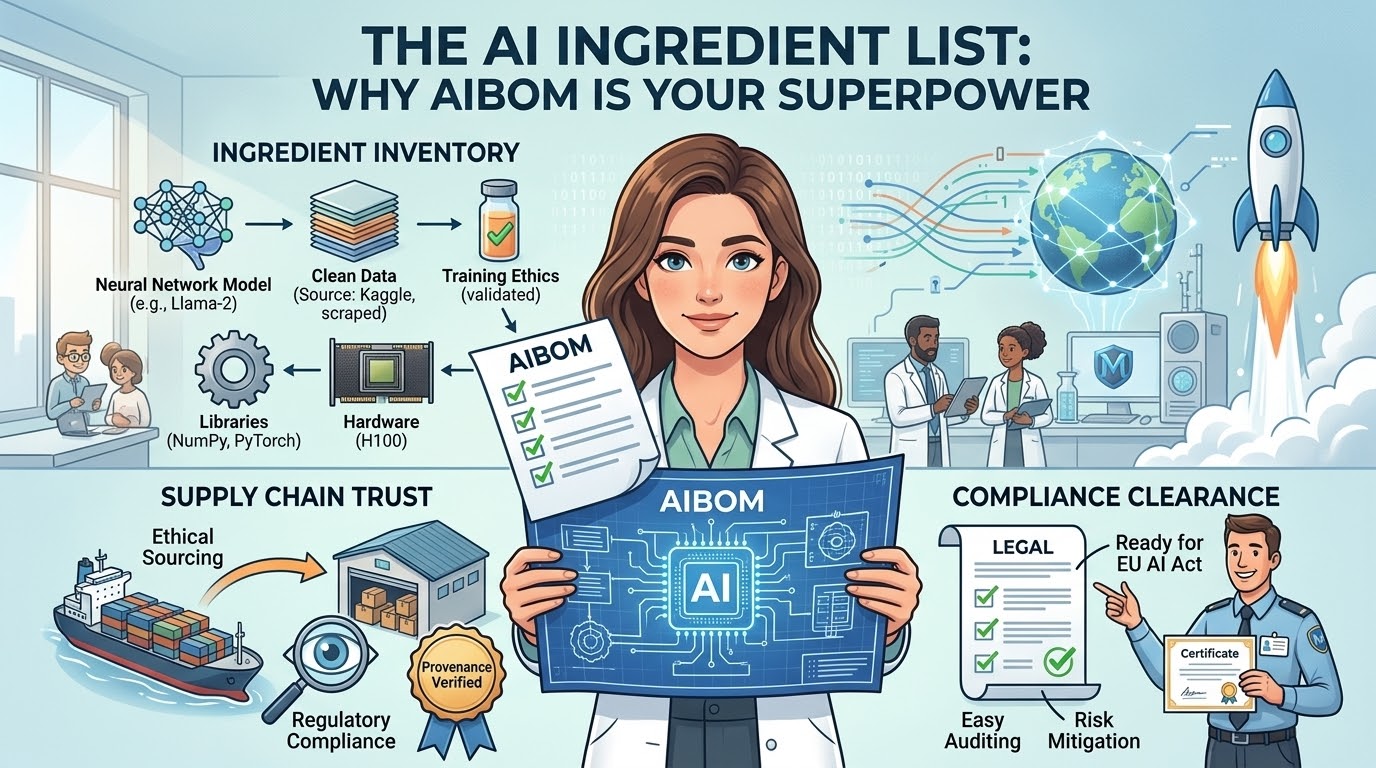
We've all accepted that the Software Bill of Materials (SBOM) is a non-negotiable part of modern security. If a vulnerability drops, you need to know exactly which applications are running that specific library.
But as we move from static software to Autonomous AI Agents, traditional SBOMs completely fall apart.
Why? Because AI agents are dynamic. Through frameworks like LangGraph and the Model Context Protocol (MCP), agents actively discover tools, reason about them, and invoke servers at runtime.
You can't secure an agent by looking at its static codebase. You have to secure its behavior.
This is why we built the AI Bill of Materials (AIBOM) at MITRITY.
Why SBOM Fails for AI
An SBOM lists the static libraries shipped in your app. But an AI agent's risk profile isn't just about its dependencies; it's about its runtime reach.
- Agents discover new MCP servers on the fly.
- A single agent might interact with dozens of different backend services over its lifecycle.
- The identity of an external MCP server can change without any changes to your agent's code.
What is an AIBOM?
An AIBOM is your live, runtime inventory of every single tool and MCP server your agents have actually invoked.
Sitting directly in the runtime path via the Mitrity Gateway or Sidecar, the AIBOM dynamically captures a composite identity for every tool call (transport, publisher, binary hashes, DNS hostnames, etc.). It doesn't guess what your agent might do. It records exactly what it did.
Why AIBOM is a Game-Changer for Enterprise AI
1. Live Drift Advisories (No More Blind Spots). Imagine a critical CVE drops tomorrow for a popular GitHub MCP server. With a traditional setup, you'd be digging through delayed static logs trying to guess if your agents used it. With MITRITY's AIBOM, the platform instantly matches the new threat indicator against your live inventory. It immediately fires a "Drift Advisory" directly to your SOC team via Slack, Email, or Webhook — before the agent's next invocation.
2. The Risk Overlay. Not all tools are created equal. The AIBOM automatically applies a curated risk profile to your inventory. Is an agent using a tool capable of arbitrary code execution? Does it have cloud admin reach? AIBOM categorizes this risk automatically so your security team knows exactly where to look.
3. Total Traceability. The AIBOM dashboard allows you to pivot instantly. Want to know exactly which agents have access to a specific database tool? Or want to audit a specific agent to see every service it has touched in the last 30 days? It's all mapped out in real-time.
Trust the Runtime, Not Just the Code
If we want to trust autonomous systems to operate in enterprise environments, we have to stop treating them like traditional static software.
AIBOM gives security teams the real-time visibility they need to finally say "yes" to deploying Agentic AI safely.
For the full technical deep dive into how the AIBOM captures composite tool identity, matches threat indicators, and fires drift advisories, read the AIBOM documentation.
MITRITY is an intent-aware governance platform for autonomous AI agents. Start a free trial or read the documentation to build a live, runtime inventory of every tool and MCP server your agents touch.