
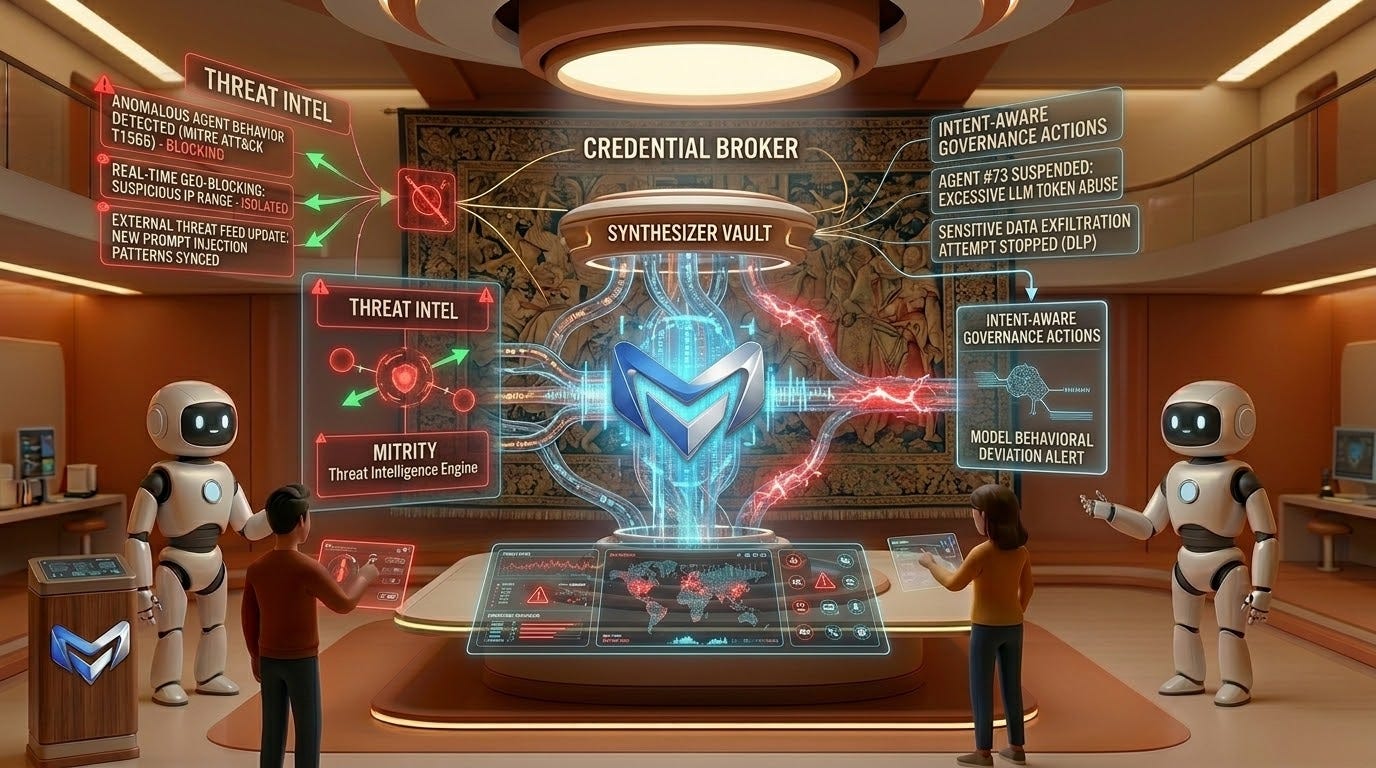
When you deploy an autonomous AI agent, you aren't just deploying code — you're deploying an independent actor that interacts with the internet, your databases, and your APIs. And just like any other endpoint, it is going to get attacked.
But traditional threat intelligence — which relies heavily on network IOCs (Indicators of Compromise), static IP blocklists, and malware hashes — falls flat when dealing with AI. If an attacker uses a clever Unicode homoglyph to inject a prompt, or an agent starts quietly enumerating your database tables because of a hallucination, traditional SIEMs won't catch it until the data is already gone.
To fix this, we built a Threat Intelligence system natively into the MITRITY Intent-Aware Governance platform. It is designed specifically for the unique vulnerabilities of agentic AI.
Redefining the "Indicator" for AI
Instead of tracking bad IP addresses, the MITRITY threat feed tracks behavior. We categorize AI-specific threats into five actionable indicator types:
- Action Patterns — specific agent workflows that indicate malicious behavior (e.g. an agent systematically enumerating a filesystem directory before making an HTTP POST to an external blob store).
- Behavioral Hashes — complex, multi-step attack patterns captured by our ML models. If an agent reads a config file, extracts a credential, and immediately attempts an unrecognized outbound connection, the model generates a behavioral hash to flag it.
- Injection Signatures — novel prompt injection techniques, like using Unicode homoglyphs to hide "ignore previous instructions" overrides from standard regex filters.
- Tool Abuse Patterns — the misuse of legitimate tools. For example, an agent querying
information_schematables recursively is a classic reconnaissance technique masquerading as a standard database tool call. - Delegation Patterns — agent-to-agent privilege escalation. If a low-privilege agent delegates a task to an intermediary, which then delegates to a high-privilege agent without a valid business-logic chain, we flag the circular attack.
The Network Effect: Privacy-First Shared Intelligence
Here is where the architecture gets really powerful. The threat feed is completely privacy-first and tenant-isolated.
We never share your tenant data, agent identifiers, or specific payload contents. But when our system detects a novel attack pattern against one tenant — say a new flavor of prompt injection — our ML models abstract that pattern into an anonymized threat indicator.
That abstracted indicator is then distributed to all MITRITY tenants via the threat feed. The result? A network effect. The more companies deploy MITRITY to govern their agents, the smarter and more resilient the entire ecosystem becomes. If a financial-services customer gets hit by a novel data-exfiltration technique on Tuesday, our healthcare customers are automatically immune to that exact behavioral pattern by Wednesday.
How It Works Under the Hood
The intelligence isn't just a passive feed you read on a dashboard; it's an active enforcement mechanism.
- Continuous updates — new indicators from our curated research team, the platform ML models, and validated community submissions are pushed to your environment via a heartbeat channel.
- Real-time gateway evaluation — the MITRITY Gateway (or Sidecar) sits inline with your agents. It evaluates every agent action against the active indicator set in real time, adding less than 0.5 ms of latency.
- Automated enforcement — when a match is found, the system immediately applies your configured response based on severity. Critical exploits are blocked instantly, while medium-severity anomalies might be held for human review or simply alerted to your SIEM.
Governance That Adapts
You can't hardcode rules for every possible way an LLM might misbehave or be exploited. Static allow-lists break the moment your agents need flexibility, and post-hoc audit logs are too slow.
By integrating dynamic, behavior-based threat intelligence directly into the inline governance layer, MITRITY ensures that your autonomous agents are protected by the collective security posture of the entire platform.
If you are deploying agents to production and want to see what actual AI threat detection looks like, dig into the Threat Intelligence documentation.
MITRITY is an intent-aware governance platform for autonomous AI agents. Start a free trial or read the documentation to put behavior-based threat intelligence in front of your agents.